
Celebrating Dr Narinder Singh Kapani

When Jaspreet and I went to San Francisco in 2022, we made a pilgrimage to the Asian Art Museum, escorted by Sonia Dhami, trustee of the Sikh Foundation, who had worked with Dr Narinder Singh Kapani for 15 years.
Seeing the historically significant artifacts that represented our heritage was an unforgettable experience, and her explanations and presence ensured that we had a much better understanding of the art and of the person who had, in no small measure, contributed to the recognition of Sikh art in the West and created a permanent niche for his collection in the museum.
Twenty years earlier, I had interviewed Dr Kapani for The Tribune. My 2002 article was titled The Man Who Bent Light. The Tribune’s Saturday supplement was then called Windows, and it was indeed a window into a man with a larger-than-life presence in the world of science, entrepreneurship, art, and the preservation of Sikh heritage.
He was friendly with my parents and had hosted a gathering in honour of my mother, Inderjit Kaur, when she visited the US in 1975 to attend the International Association of University Presidents in Boston and toured various cities with my father, Giani Gurdit Singh, after that. She was then Vice-Chancellor of Punjabi University, Patiala, and one of the three women heading a university in the world. We met in New York, in the late 1980s, courtesy of his good friend, Dr Inderjit Singh, who I was very close to. IJ was a founder trustee of the Sikh Foundation, and he often spoke of how Dr Kapani could meet heads of state and government as an equal.
Dr Kapani’s birth centenary fell on October 31. In the following article, I discuss Dr Kapani’s achievements and legacy, published in The Sunday Tribune's Spectrum section on November 1, 2026.

Chasing light
The extraordinary legacy of Dr Narinder Singh Kapany — ‘Father of Fibre Optics’, a pioneering entrepreneur and a champion of Sikh heritage
by Roopinder Singh
Some people become famous in their lifetime, others only after they pass on. Dr Narinder Singh Kapany was both; his work made him famous, and his legacy endures. Six years after he passed away, we mark the birth centenary of the man from Moga who was brought up in Dehradun; earned major academic laurels in London, and later Rochester; became an entrepreneur in Palo Alto and left behind a global legacy that furthers education, entrepreneurship and Sikh heritage.
Fundamentally, his work built the foundations for the fibre-optic technology that underpins the modern digital world.
In its obituary, The New York Times quoted Jeff Hecht’s 1999 history of fibre optics, City of Light, which noted: “Between 1955, when Dr Kapany received his doctorate, and 1965, he was the lead author or co-author of 56 scientific papers — an astounding 30 per cent of all research published in the field during that decade. He wrote the first book on fibre optics and, in a 1960 cover article he wrote for Scientific American, even coined the term itself.”
In 1956, Dr Kapany was referred to as “an experimenter in the new field that he calls ‘fibre optics’”, highlighting his work on the gastroscope.
So, which aspect do we talk about first? We could start with the ‘Father of Fibre Optics’ title, but the man who became that comes first. Narinder Singh was born on October 31, 1926, at his mother’s ancestral house in Moga. Kundan Kaur was a Sodhi, and Narinder would later be told by his aunts that all the land he could see from the roof belonged to the family.
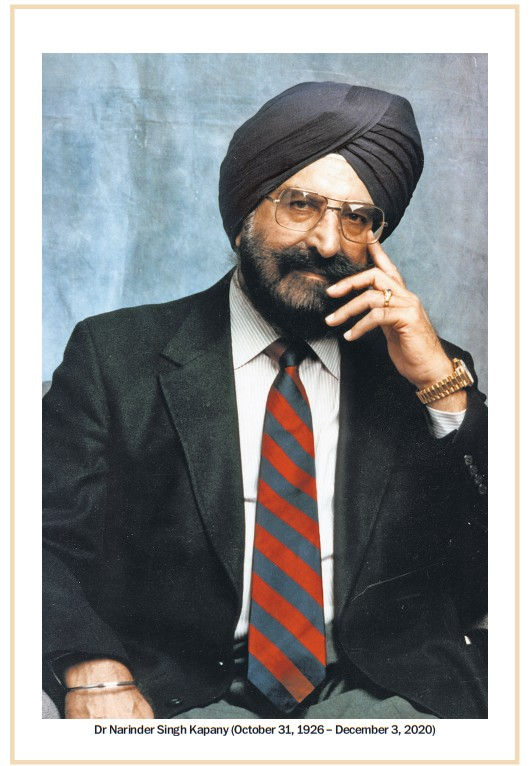
Fortunately, we know a lot about him and his family, primarily from his 2021 memoir, The Man Who Bent Light. His father, Sundar Singh, a Royal Air Force reconnaissance photographer in World War I from Patiala, worked as a contractor in Dehradun, where the family settled and the children went to school.
Kapany’s grandmother consulted a 200-year-old illustrated manuscript of Janamsakhis to teach him about his heritage, and its beautiful miniature paintings instilled a lifelong passion for Sikh art. It was in Dehradun during Partition that it fell upon young Narinder to protect his staff, which he did. However, the depravity he witnessed then left a scar and pushed him into adulthood.
After graduation, he worked in an ordnance factory in Raipur, where he learned more about optical instruments, including hands-on work in glass cutting, grinding, polishing and edging. Joining the graduate programme at Imperial College, London, in 1952, and having a mentor like Prof Harold Hopkins allowed him to pursue his passion for finding ways to transmit light and images through flexible bundles of optical fibres.
During holidays, he met “a stunning young woman… her look both demure and assertive, humble but regal. A woman with the softest hand and, by far, the firmest grip”: Satinder, who was studying English literature. Less than three years later, she would marry the “glass man”, as she first called him, and remain his life companion for 62 years.
After graduating, he worked at Bar & Stroud, an optical engineering firm, for a few months before joining Imperial College for his PhD. He received a small stipend and continued his research, and his romance. His life changed in the years he spent in London. He conducted his experiments, wrote his paper, and married the woman he loved at the Shepherd’s Bush Gurdwara in 1954.
Although he planned to return to India and open his own optics manufacturing company after his PhD, he went to Italy to present his paper and was persuaded to join the faculty at the University of Rochester in New York, USA, in 1955. That year, he and Satinder moved to the United States and began their life together there.
After his time in Rochester and Chicago, they settled in California, where his entrepreneurial instincts resurfaced. He founded Optics Technology in 1960. The West Coast became their home, and he devoted his time to teaching at the University of California (UC), Berkeley, UC, Santa Cruz, and Stanford University.
He accumulated many patents, well over a hundred, and also went on to found businesses. When Optics Technology Inc went public in 1967, Kapany was considered the pioneering Indian entrepreneur who took a company public in Silicon Valley. It had noted investors on board, and Kapany headed it for 12 years before stepping down to launch his highly profitable venture, Kaptron, in 1973, which he sold, and later started K2 Optronics in 2000.
When I asked him why he named his company after the world’s second-highest peak, he laughed and said that “one must be modest”.
Raj, his son, worked with him on his ventures while forging his own path as an entrepreneur and angel investor. Naturally, these ventures focused on optics and practical applications of his research, and they were hugely lucrative.
Dr Kapany’s use of his wealth defined his legacy. In 1967, soon after his first company went public, he established The Sikh Foundation to promote Sikh heritage, art, and philosophy. As he said, “The focus was the richness of heritage,” and to that end, he and his wife, Satinder Kaur, founded the English-language Sikh Sansar magazine in 1972 and ran it for five years.
Kapany’s heart was in academia and research, and he also founded and directed the Center for Innovation and Entrepreneurial Development at the University of California, Santa Cruz. Much of his focus on academic endowments was within the University of California ecosystem. The Kundan Kaur Kapany Chair of Sikh Studies at UC, Santa Barbara, was endowed in 1997 in honour of his mother. He endowed the Chair of Optoelectronics at UC, Santa Cruz, in 1999.
In March of the same year, the landmark Arts of the Sikh Kingdoms exhibition, marking the tercentenary of the Khalsa, opened at London's Victoria and Albert Museum and was inaugurated by (then) Prince Charles. Kapany sponsored the exhibition. It subsequently travelled to the Asian Art Museum in San Francisco in September 1999 and to the Royal Ontario Museum in Toronto in October 2000, where additional works from local Canadian Sikh collections were included.
Susan Strong edited the catalogue, with many eminent contributors, including Khushwant Singh, Nikky-Guninder Kaur Singh, Patwant Singh, BN Goswamy, and FS Aijazuddin. It has a permanent place in many libraries. The Sikh Foundation has been a forum for many academic and cultural exchanges.
“Uncle Kapany was an extraordinary source of inspiration, who nurtured my love for translating Gurbani and deepened my fascination with Sikh art. I so miss his booming voice and infectious laughter echoing over the phone across the miles, reaching me even in distant Maine. Kiki Kapany keeps his spirit and legacy alive through her numerous innovative and valuable initiatives,” says Prof Nikky-Guninder Kaur Singh, Chair, Department of Religious Studies, Colby College, Maine, US, who is a trustee of the foundation.
Sonia Dhami, who worked with him for 15 years and is also a trustee of the foundation, says: “When I think of him, I don’t first think of fibre optics or patents. I hear his booming voice. I remember his irrepressible energy, his sharp questions and his impatience with wasted time. I remember our Friday meetings at his home in Woodside, where even in his final years, despite considerable challenges to his health, his mind stayed firmly fixed on what needed to be done next. He was always looking forward.”
Entrepreneurship brought the wealth he used for these philanthropic activities, and in 2012 he endowed a professorship in entrepreneurship at UC Santa Cruz’s Baskin School of Engineering.

His daughter, Kiran (Kiki) Kapany, puts it well: “What I remember most is how vibrant he was. He was full of energy, endless curiosity and ideas, with a very powerful presence and a great sense of joy. He loved knowledge, art, travel, politics and life itself, and he was always thinking about the next idea. He and my mother also believed deeply in discipline and health, and they taught us by example to care for both body and mind. He wore his turban proudly and unapologetically, and my parents made us proud of our heritage at a time when there was very little awareness of Sikh history or culture in the United States.
“To understand my father's legacy is to see a life of deep purpose and commitment. My father spent his career in fibre optics, helping carry light and information around the world. Through his philanthropy, he worked to preserve our heritage, supporting knowledge, art, faith, and identity for future generations. He spent his life pursuing light, and now that light lives on in all of us.”
Dr Kapany passed away on December 3, 2020. In 1999, Fortune magazine named him one of the seven “Unsung Heroes” in its Businessmen of the Century issue. A decade later, Charles Kao received the Nobel Prize in Physics for his work on light transmission in fibres for optical communication, prompting discussion of Kapany’s pioneering contribution to the field, with many saying his claim was ignored.
Of course, Kapany received many honours, including the Padma Vibhushan, awarded posthumously in 2021.
Re-reading his memoir, the man who plucked the “Maharaja’s mangoes” in Patiala; cycled around in Dehradun; stretched his stipend while researching and romancing in London, and founded companies and shaped his legacy in Palo Alto shows how a determined man can overcome various setbacks and accomplish with vision, focus and hard work.
Dr Kapany could be courtly or no-nonsense, as the occasion demanded, and one time, I saw both avatars in short order — encouraging a youngster and at the same time being blunt, to put it politely, with a bureaucrat. When I asked him how many patents he had, he smiled and said: “After a hundred, you stop counting.”
His love for Sikh heritage was something we talked about, and he asked me many questions. His attention could be intimidating. He narrated the story of how he had fallen in love with the painting of Rani Jind Kaur, painted by George Richmond in 1863, when she was in exile in England. “When I saw it, I knew that I wanted to have the painting, and I did,” he said, narrating the story of how he persuaded the American doctor and art collector Dr William Ehrenfeld to sell the painting to him.
“I have loaned it for exhibitions to San Francisco’s Asian Art Museum and the Smithsonian Institution in Washington, DC, but now it hangs proudly in my living room,” he added, with an unmistakable note of pride.
Narinder Singh Kapany left his mark in the worlds of science and the arts. He helped create an information technology infrastructure that underpins modern communications; he was a serial entrepreneur who used his wealth wisely by investing in academic advancement and artistic heritage. He left an impact that outlasted him.















Comments