
Seeing Socrates in a new light

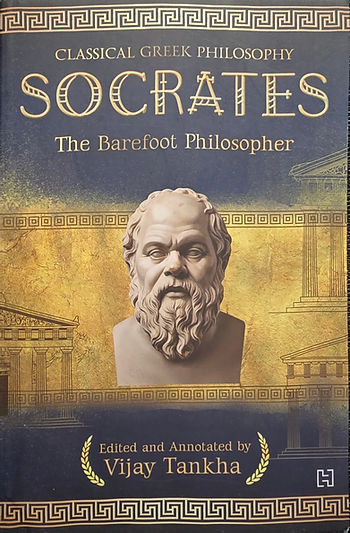
Socrates: The Barefoot Philosopher
By Vijay Tankha
Hachette India
Pages 240. Rs 499.
Review by Roopinder Singh
How do you solve a problem like Socrates? How do you pen down an account of a man whose writing does not survive? How do you write about a philosopher whose works are unavailable but widely quoted, indeed form the basis of much of Western philosophy? How do you construct the life of a person whom most scribes have seen as they want him to be?
We all know Socrates, and we don’t know him. Widely considered among the wisest men in history, a statement attributed to him asserting that he is wise enough to know that he does not know, is one of the famous sayings that has passed down through centuries. He dangerously challenged his fellow Athenians into debate, exposing their preconceptions and opinions.
Instead of constructing yet another portrait of the person, the author allows us, the readers, to form our own—through the writings of contemporaries and those who came later. We all know Plato, his most famous student. This book also acquaints us with Aristophanes (Socrates’s constant companion), Diogenes Laertius (who wrote a history of Greek philosophy), Xenophon (an associate of Socrates), and others whose writings are quoted.
What we have are passages from their works that inform us, including one where he wears sandals and explains why! Starting with his life and times, we go to images of the man as reflected in various accounts; the charges of impiety against him and his own behaviour, which was devoted to piety and ethical living; his obedience to the laws to the extent that, following his death sentence, he refused to escape from the prison even when his friends arranged it.
Love, as the author says, is one thing that Socrates affirms he knows about…. “There are at least two different words that differentiate erotic from non-erotic (filial) love. Eros, the god of love, gives his name to the former, as does his mother Aphrodite, while ‘philos’ does duty for affection and friendship.… If desire is a basic fact of human existence, eros must be controlled, philosophically, by logos (reason).” Both Socrates and later Plato find a way to redirect the erotic impulse into one of love, not of the body, but of the soul.

We all know that for Socrates, philosophy was to be practiced by dialogue or conversation. His stress on instruction through interrogation fitted well with his claim of not knowing. We know him through the conversations that were later written by those who recalled them. Of course, moral behaviour, right conduct and justice were primary concerns. The important thing to remember is that Socrates would not give out moral instructions; his dialogues bring out the dilemmas and issues regarding morality. He stressed cross-examining those who said they knew. The initial framing of the concept was often exposed as inadequate and contrary to the beliefs that the person holds dear. It is then chipped, expanded, questioned and shaped into something better, but not always adequate. It was not unusual for the discussion to lead to an impasse. The Socratic method confronted a person with his own ignorance, pushing him to abandon his false beliefs.
While in college, the weekly Philosophical Society meetings encouraged us to debate.They attracted many of the top academics of the time, including the now late Profs Ramu Gandhi, and JPS Oberoi, which gave us students tremendous exposure. The Symposium at Dr Gupta’s house was another education. Studying philosophy did not make me an intellectual. Far from it. Yet it continues to shape me throughout my life because of both what I studied and how it was taught to me by eminent teachers like the late Dr RK Gupta (whose house the meetings were held in), Prof Ashok Vohra and Prof Tankha, who, while teaching us Greek philosophy, made it come alive. Reading the book brought back memories, rekindled my love for Plato’s dialogues, and reignited a passion for a discipline that I leaned on as I navigated my life.
This easy-to-read book has a useful glossary, a timeline of important dates, and a short bibliography. It is not Socrates’ biography, nor is it a collection of his teachings per se. It whets the reader’s appetite for more. The book is important not only because of what it says, but how it says it. The curated selections of excerpts from Greek authors who wrote about Socrates allow us to frame our own understanding of the famous Greek philosopher.
This review was published in The Tribune on August 2, 2026
















Comments